Why Knee Pain on the Stairs Isn’t Just About Your Knees
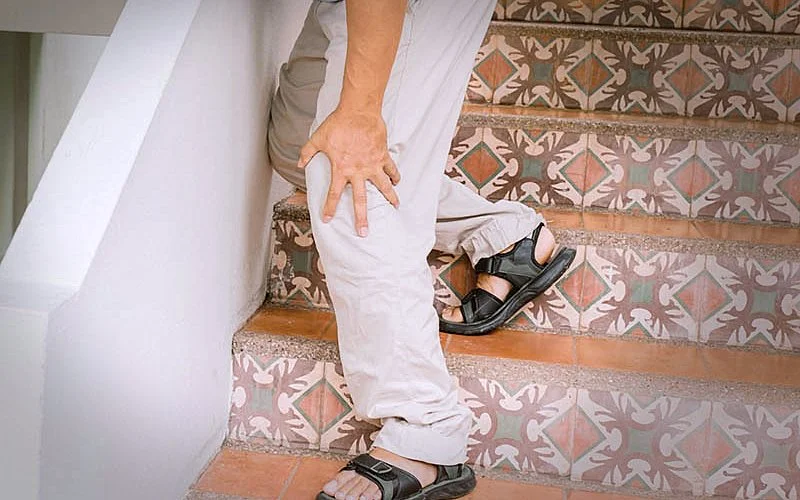
Knee pain on the stairs is one of the most common complaints in orthopedic care, yet in many cases, the knee itself is not the primary problem.
At Aim Sports Medicine, we frequently see patients who come in for knee pain, only to discover that the root cause lies in how their entire lower body is functioning together.
Studies estimate that up to 25% of adults experience anterior knee pain, with stair climbing and descending being among the most aggravating activities. What many patients learn during their evaluation is that the knee often serves as the “middle joint” of the lower body, absorbing stress generated by dysfunction in the hips or ankles.
The Knee: Where the Symptoms Show Up
During level walking, forces across the joints remain relatively moderate. However, stairs significantly increase mechanical demand:
● Walking downstairs can generate forces up to 3 to 4 times your body weight at the knee joint
● Stair climbing requires substantial concentric muscle effort, while descending requires controlled eccentric loading
If the knee is not tracking properly, the patella, or kneecap, may not glide smoothly within its groove on the femur. Instead, it can create friction and irritation, commonly referred to as Patellofemoral Pain Syndrome.
At Aim Sports Medicine, we look beyond where the pain is felt and identify why that stress is being placed on the knee in the first place.
The Hip: The Driver of Alignment
The hip plays a critical role in controlling the position of the femur during movement. In particular, the gluteus medius stabilizes the pelvis and prevents excessive inward rotation.
Research shows that individuals with knee pain often exhibit reduced hip strength and impaired neuromuscular control, contributing to faulty movement patterns.
When hip stability is compromised:
● The knee collapses inward, also called dynamic valgus
● Joint loading becomes uneven
● Patellar tracking is disrupted
At Aim Sports Medicine, we prioritize strengthening the hip as a foundational step in relieving knee pain. By restoring control at the source, we reduce unnecessary stress on the knee joint.
The Ankle: The Foundation of Movement
Just as important as hip stability is ankle mobility, specifically dorsiflexion, or the ability of the shin to move forward over the foot.
Limited ankle mobility is more common than many realize. Research suggests that restricted dorsiflexion is strongly associated with compensatory knee mechanics and an increased risk of injury.
When the ankle lacks mobility:
● The heel may lift prematurely
● The foot may rotate outward
● The knee is forced into unnatural movement patterns
At Aim Sports Medicine, restoring ankle mobility is a key part of treatment. When the ankle functions properly, it allows the entire movement chain to operate more efficiently and reduces strain on the knee.
Why Going Down Stairs Hurts More
Many patients report that descending stairs is more painful than climbing them. From a biomechanical perspective, this is expected.
Descending requires:
● Controlled eccentric contraction of the quadriceps
● Precise coordination and balance
● Effective shock absorption through the kinetic chain
If muscular control is insufficient, the load is transferred directly into the knee joint structures rather than being absorbed by the muscle. This leads to increased compression, irritation, and discomfort.
At Aim Sports Medicine, we focus on retraining these movement patterns so your body can absorb force the way it was designed to.
A Modern Physical Therapy Approach at Aim Sports Medicine
At Aim Sports Medicine, treatment goes beyond symptom management. We analyze how your body moves as a complete system.
A comprehensive plan for stair-related knee pain typically includes:
● Hip strengthening
Building stability in the gluteal muscles to improve alignment and reduce knee stress
● Ankle mobility work
Restoring proper dorsiflexion to normalize movement patterns
● Neuromuscular re-education
Training your body to activate the right muscles at the right time
We also use advanced tools, such as force plate technology, to assess movement patterns, identify imbalances, and track progress with precision.
Take the First Step Toward Relief
Knee pain on the stairs is not simply a sign of aging or wear and tear. It is often a signal that your movement system is out of balance.
At Aim Sports Medicine, we focus on identifying and correcting the root cause, not just treating the symptoms. By improving hip strength, restoring ankle mobility, and retraining movement patterns, we help you move with confidence again.
Avoiding stairs may provide temporary relief, but addressing the underlying issue leads to long-term results..
Contact Aim
If you have a question about our physical therapy, call us, and we'll provide you with our professional opinion. We are ready to support you during your healing journey.
Call or Text us today: (310) 937-2323